4 Reasons Why You May Need to Accelerate Your Learning

PLoP Portland

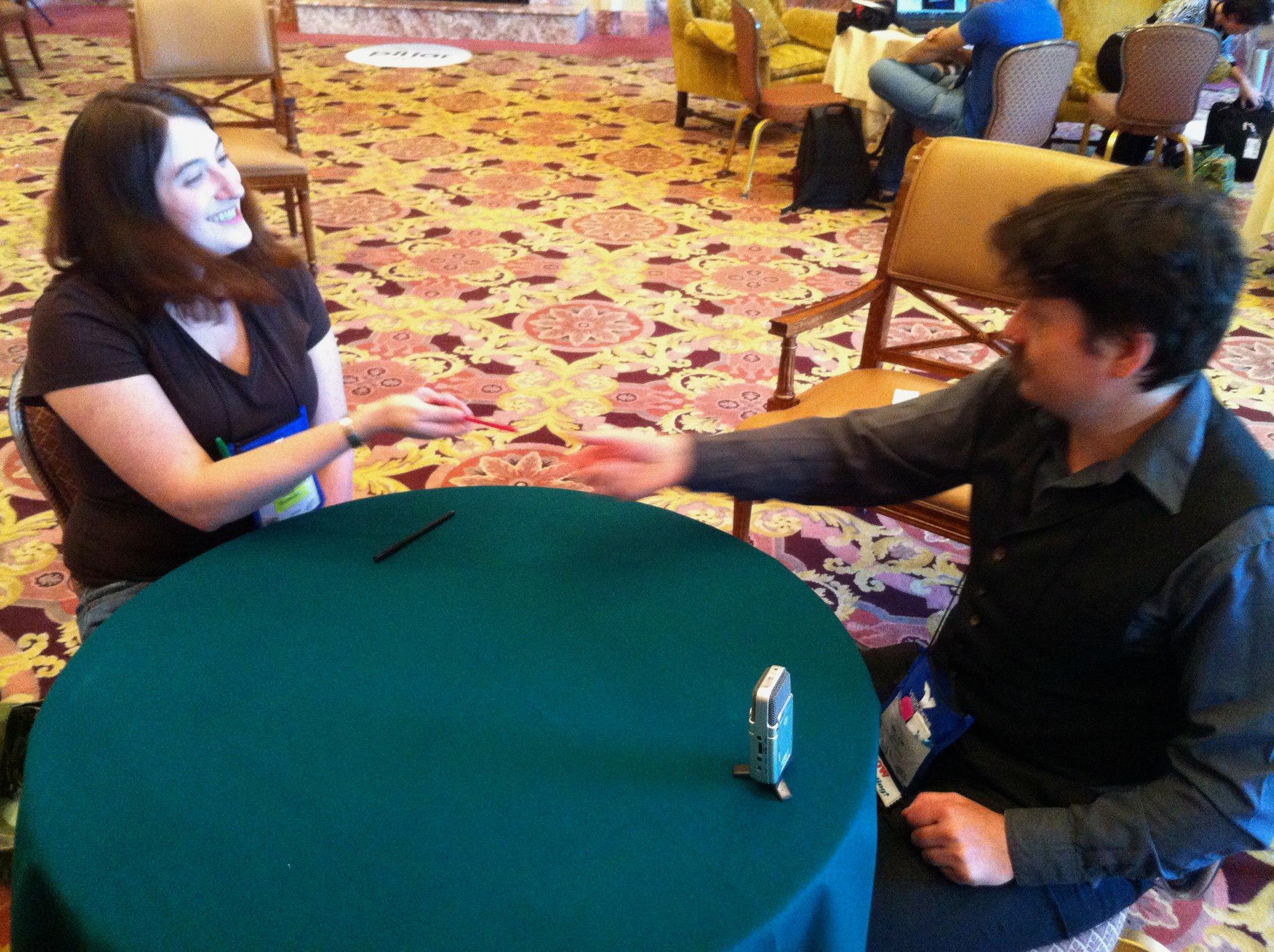
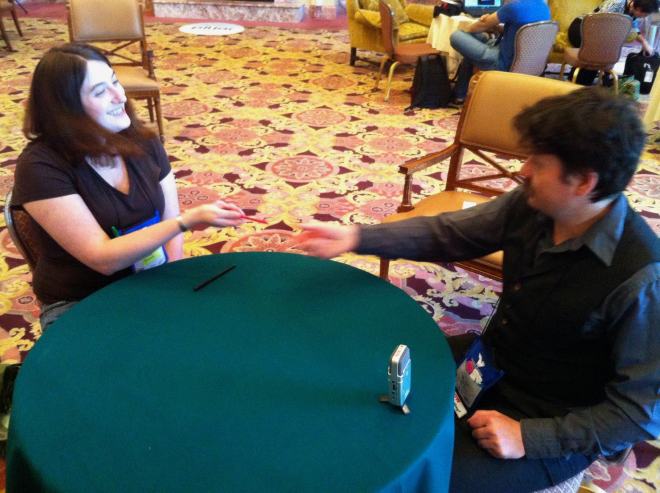
Willem Larsen at PLoP '11, hunting German and Japanese! (CC Daniel Cukier)

I’ve just returned from the PLoP 2011 conference in Portland, OR, a conference all about sharing and communicating strategies of success across fields. I have some new understandings of how to approach the sharing of the principles of accelerated learning. I’m now thinking in terms of patterns. If you haven’t heard of the term, patterns are written in a particular format for sharing successful strategies; unlike the idea of “best practices”, where one might think that one successful tool can be used anywhere for anything, patterns are extremely contextual. There is an art to applying patterns.

ACCELERATED LEARNING is itself a pattern. So, what is the context for which it’s suited? Who needs to accelerate their learning?

If any of these are true:

  • You love innovation and learning for its own sake…
  • You have an urgent need to improve or learn under extremely constrained conditions, such as limited time and budget…
  • You have high standards for personal or professional reasons…
  • You need to perform in a “do or die” environment, i.e. the medical, military, aviation, or other field that compels high performance.

Then you may want to look at tools that will accelerate your learning and the learning of others.

Conventional educational methods are not designed for rapid, high quality results.

  • Institutions prioritize time-spent-in-seats for budgetary and societal reasons.
  • Institutions prioritize standardized results and consistent experiences in their populations.
  • Learning styles and backgrounds vary wildly among student and employee populations.
  • The most effective continual learners are self-directed, but it’s difficult to transfer responsibility for learning to individuals conditioned to wait for and satisfy instructor or supervisor direction.
Therefore, look outside of conventional methods to accelerate your learning. 
  • Investigate and imitate “positive outliers” – teachers and students in institutional environments who are performing higher than the rest of the population.
  • Investigate and imitate successful learning in unconventional environments and “do or die” fields; emergency medicine, military training, flight training, endangered language revitalization
  • Isolate and apply the fundamental principles common to these environments;
  • Focus on that which is ALIVE, prioritize FLUENCY over knowledge, boost SIGNAL STRENGTH in communication, NARROW SCOPE of the skill or information you want to transmit in any moment, DESIGN YOUR ENVIRONMENT to immerse the learners in the learning experience.
The craft of accelerating learning is a skill itself; there is a long learning curve. It’s somewhat like a mental martial-art. You START AT THE BEGINNING by using basic principles to design simple accelerated learning environments for small groups of people. As you increase in skill you are able to support larger and larger learning communities.

New “Get to the Party” Roadmap for Reaching Intermediate Proficiency

Valborg River Race language hunting
It’s the Valborg River Race in Sweden, of course!

I’ve been working to make the race to “getting to the party” smoother and more clear. I’d love feedback on this new guide for language hunting to intermediate proficiency.

Download the guide here.

4 Ways to Design Accelerated Learning

mouse turtle accelerated learning image

You can actually stop accelerating just short of ramming speed, please.

There are four major elements that are fundamental to accelerated learning; any attention paid to them will improve the effectiveness of your teaching and the success of your students. Attention on any one of them alone can create a radical transformation in your students’ ability, and what you think is possible. Harness all of them and the sky’s the limit!

These elements are: Performance, Signal Strength, Focus, and Environment.

(High) Performance

Your new goal for your students is not to have them know a lot about your subject, but to gracefully perform at a high level in your subject’s context. Prioritize doing over knowledge.

In the fluency hunting system, we call this technique (tq) “Fluency”.

(Boosted) Signal Strength

You need to remove all hesitation and ambiguity in reception of what you’re sharing to your students. No trickery, guesswork, or puzzling.

In the fluency hunting system, we call this technique (tq) “Obviously!”.

(Narrowed) Focus

Zero in on the number objects, or chunks of information, that your students can easily focus on.

In the fluency hunting system, we call this technique (tq) “Limit”.

(Designed) Environment

Remove visual, auditory, and kinesthetic distraction and noise from the environment. Intentionally create as close to 100% of the learning environment as possible.

In the fluency hunting system, we call this technique (tq) “Set-up”.

Irish language hunting for Fall 2011 in PDX

Here’s an announcement from fellow language hunter and Irish speaker Brían Ó hAirt. This is a good example of how language hunting can be blended with conventional offerings to meet the expectations of all kinds of students:

brian hart language hunter image

Brían Ó hAirt, Irish speaker and Musician

I’m excited to be offering Irish language classes again at the AudioCinema building in SE Portland, starting September 22nd ending on November 27th.

Classes will run from roughly 6-7 p.m. on Tuesdays for Advanced Beginners, on Wednesdays for Absolute Beginners, on Thursdays for those interested in playing ‘Tea With Grandpa’ and on Friday for Intermediates.

Here are the class descriptions if you are unsure of your language skills:

Absolute beginners:  For students with little or no Irish language skills.  Immersive techniques help to accelerate the learning process to get beginners up and speaking the language within a few minutes of starting class.  Grammar and spelling will be touched upon but general speaking and listening skills will be the main focus of this class.  SPREAD THE WORD ON THIS COURSE!

Advanced beginners:  For students with basic Irish language skills.  Immersive techniques will be used in this course but with equal focus on spelling and grammar.  Building vocabulary and an understanding of verb tenses and idioms will be the main focus of this class.  FOR YOU WHO WERE IN MY BEGINNERS COURSE IN THE SPRING!

Intermediates:  For students with moderate Irish language skills.  Immersive techniques will be used in this course with an aim of exploring difficult aspects of the language as well as researching individual students’ questions.  Furthering students’ understanding of idioms and conditional and habitual tenses will also be focused of in this class.

Tea With Grandpa:  Immersive game play for students of all levels and ages from absolute beginners to fluent speakers.  This game is interactive, fascinating, challenging and most of all FUN.  Come learn the skills to hunt language from a native speaker while immersing yourself in Irish to build language skills pertaining to everyday situations and conversations.  (www.languagehunters.org)

We’ll be working with a different pay setup for the Fall semester: $75-100 sliding scale for a six-week course or $15 per person for drop-ins.  ‘Tea With Grandpa’ will also run concurrently with the language classes for six weeks.  The sliding scale rate will be $30-60 or $10 for drop-ins.  The change in fees and sliding scale offering is necessary to cover the rental cost of the studio beyond meeting the financial needs of the instructor.  In the near future the studio will receive non-profit status and a new name, which will be reflected in the courses and events offered!  Stick with us–great things to come in early 2012!!!

I look forward to working with you all again and hearing about your summer adventures in Irish language learning.  If you’ve any questions, email me at ohairt (at) yahoo dot com.

Feicfidh me go luath sibh!

Brían Ó hAirt
Bio:
Brían is a native of Saint-Louis, Missouri who was introduced to Irish in his early teens.  He quickly became a dedicated student of the language, which led him to study Irish at UW-Milwaukee’s Center for Celtic Studies as well as at the University of Limerick’s Irish World Music Center and the National University of Ireland—Galway where he spent two summers immersed in the language of the Conamara Gaeltacht.  Upon returning to the States he began teaching Irish for the Saint-Louis branch of Cumann na Gaeilge and as well as for prestigious Washington University.  He has subsequently led language workshops and taught at various immersion programs throughout the United States.  He is no stranger to the tight knit language communities both here in the US and abroad in Ireland and remains an advocate for Gaeltacht culture and in particular sean-nós singing and dancing.

What’s in the Way of an Update

Failed meet-ups. Limited willing test subjects. Insecurity of my developing skill. Significant distance from the LH Headquarters.

... in the way....

Challenge after challenge- I was beginning to stress out. What will the Language Hunters reading this blog think when I feel like I’ve made so little progress? How can I have anything valuable to say when I seems as though all of my plans have crashed and burned? I wanted to hide my hunting failures. I was worried I was falling further and further away from Language Hunting.

I was at a loss in regards to detailing my adventures. Then, the other day, I realized something- I bet I’m not alone.

I imagine that any individual who has taken up Hunting on their own accord has felt like this at some point or another during their hunting acquisition. “Yes, I’ve watched the videos,” you might say. “Yes, I’ve played the game with a couple of friends. But, where do I go from here? What, exactly, can I do with this, right now?”

With all of these challenges “in the way”, Hunting can seem like a difficult task to really motor on. However, today I thought, what if these bumps in the road are not “in the way”. What if, instead, they become “the way”? In my mind, the distinction is the difference between hitting a wall that stops you in your tracks, or creating a new path to get to the other side of the wall.

I’ve got to change the way I go about things if I want to keep on going. Today I’m thinking: If native speakers won’t come to me, how can I go to them? If I’m scared of looking like I don’t know what I’m doing, how can I be more comfortable? If I’m far away from the all the Hunting activity in Portland, how can I make my own events where I am?

Are there any other novices out there who have come across the same problem? Did you move forward? If so, how?

Until next time,

Maggie

3 New Insights: Taking the Language Hunt to Agile 2011

language hunting polish image agile2011

Willem hunting Kate's Polish language at Agile 2011 (Picture by David Koontz 2011)

I spent last week at the Agile 2011 conference in Salt Lake City, held for an exciting international subculture of software developers and IT professionals known as “agilists”. The conference was a really fun and touching experience; I presented a 3 hour language hunting session Monday morning, the first day, and then had the rest of the conference to play games with fluent speakers from around the world. I got farthest in Polish!

The Agile community is a thrilling group of people to be involved with, full of old friends, new friends, and friends-as-yet-unmade. The stand out quality of this crowd is the community willingness to try on new ideas and paradigms, especially as they have to do with teaching, learning, and games.

That last part is the kicker.

There is a whole lot of explaining that I therefore simply didn’t have to do; as I ran games in the Open Jam (see the picture above), agilists may have sat down to play feeling skeptical, but they called Full as believers. This goes back to my feeling that intelligence (founded on hundreds of hours of game play) is not measured by an ability to compute or analyze, but by willingness – the openness to new experiences.

There are some major new insights about game play that I’ve taken from the past week. Two are language related; the last is about application to non-language domains.

Full or Killing Fairies?

As many of you know, killing fairies is the act of translating from one language to another, asking fluent speakers to “tell us what that means” (by implication, what English thinks that “means”). We avoid this for many reasons, not the least of which is every second spent translating is time spent not fluently conversing. Also, no word in any language exactly corresponds to any other word in another language, and therefore translating produces a false equivalency. The mother tongue brain (i.e., my English brain) is happy, but the new language brain’s growth is stunted and off course.

Now to a certain extent, our mother tongue brain will do this spontaneously, when interacting with a new language. It’s a natural part of growing that new brain; there is some subconscious competition that crops up. No big deal. Before you know it, you’ve habitually looked for and found what you think the new piece of language “means”. No problem, just let it go and keep copycatting.

The problem is when you do it on purpose, and invest energy in it. Yikes!

That’s when you see players struggling, the game getting slower and slower. One thing I’ve seen several times, surprisingly with very willing (and therefore plenty intelligent) agilists, is a glazing to the eyes accompanied by slow play. When I ask, “are you Full?” I get “no” as an answer. When I ask again later, same response. What is going on?

What I’ve finally discovered is happening is that the new player is translating internally; though on the outside, they may no longer ask for translation, on the inside, they are busy writing a Polish-English dictionary! Which is a big project, as you may imagine.

Therefore! If you see a willing, intelligent player struggling early on, appearing full with glazed eyes or slow hands and paper face, but answering that they are not full, then you have a fairy killer on your hands. Mark technique Killing Fairies, give them a short explanation that internal translation counts too and already is slowing them down, and keep playing.

They will experience a feeling of “letting go”, going with the game, and their enjoyment level (and language acquisition) will shoot up within a minute or two. Remember, it’s a Copycat game, not a learning game…

The solution is simple; the diagnosis has taken a while!

[Thanks especially to Simon McPherson and Lulu Lin for helping me see this]

The Exhilaration of Being Hunted

Over the years, I’ve had folks ask “won’t fluent speakers get annoyed at all the repetition in language hunting?” I’ve always said no to this. It just hasn’t been my experience – at worst they tolerate it, but mostly enjoy it.

I was in the unusual position this last week of really being surrounded by native fluent speakers of other languages, and so had the point particularly hammered home.

Speaking specifically about native speakers of other languages (not those who learned it in a classroom), there is a consistent “exhilaration” to being hunted. A feeling of “wow!”. With Kate’s Polish, Ariadna’s Catalán, Jonathan’s Parisian French, Carsten’s Danish, and others, the fluent native speakers expressed in their body language and words a full engagement in the act of being hunted itself.

This is amazing, if you think about it. They aren’t learning a new language, and I specifically ask them not to use hand signs or participate in the game as a normal hunter, to preserve the fluency of their language (hand signs tend to slow speech down and alter it).

And yet, they are experiencing their own flow state, their own engagement in the play of the hunt. My sense of the “why?” for this positive experience may in part have something to do with the unexpectedness of hearing one’s native tongue far from home. I need to start interviewing native speakers more on their experience of this – there are some great implications here for revitalizing heritage and endangered languages.

So as you hunt languages around the world, and worry about how fluent native speakers will react to play, let me reassure you – it’s gonna be great. And you’ll have a new friend, to boot.

[Thanks to my new friends, Kate Terlecka, Jonathan Perret, Emmanuel Gaillot, Ariadna Font, and Carsten Jakobsen, for midwifing this insight]

A Bite-sized Piece for Agilists

My last insight came from many conversations with Agile coaches and trainers who essentially said, “It’s great, I love it, I’m in, but what’s the next step?”. This question applies to anyone trying to transfer the language-based experience of accelerated learning principles to a different field.

So I tried out a bite-sized answer during the conference, and it seemed to stick. I’ll keep honing it, but essentially it boils down to 4 things: techniques Fluency, Obviously!, Limit, and Set-up. I think this will help out anyone in this position, with a non-language skill they want to teach.

If you only take away 4 things from fluency hunting, take away these: change your goal to competency rather than knowledge (tq Fluency), remove all ambiguity and guessing (tq Obviously!), shrink your training scope at the start to the smallest digestible chunks and add one at a time (tq Limit), and take seriously the design of your learning environment by limiting and boosting obviously! all around you (tq Set-up).

I’ll be blogging more about this last item in the coming days – till then, good hunting!

Catalán Language Hunting at Agile 2011

I hope to put up a fuller “no-grief debrief” of games at Agile 2011 soon, but in the meanwhile here’s a short video of me hunting the Catalán language from Ariadna, a native speaker (and a great player!). She was so excited to hear her native language, she got it on video to send to her family.

This is one of the great joys of language hunting; seeing the exhilaration in a native speaker when they hear their own language coming out of a new friend’s mouth, far away from home. Just imagine!


Novice Notes: Getting into the Flow

language hunter image

The Language Hunter's Path

This week I made some of my first attempts at leading a Mandarin Chinese Language Hunting game. I’ve studied the language for about two years, and although my intonation isn’t perfect, I thought it would be a fun one to start with. Applying Technique Mumble shifted the focus away from the more complex facets of Mandarin (i.e. tonality) and gave room for more attention to the structure of Hunting.

The other players had never Language Hunted before and, honestly, prior to the first round, I had never lead an entire game on my own either! A sense of excitement filled all of us.

We completed the first few rounds but not without sputters of confusion and revision throughout.

The most difficult aspect for me, thus far, is knowing (or perhaps remembering) where to go next within the game. At the Irish Hunting Workshop, a few weekends ago, we had a huge “Getting to the Party” (what we call reaching the Intermediate Level of a language) poster on the wall which pin-pointed the crucial topics that needed to be included in the game. As of yet, without something or someone to guide me, the sequence of adding bits of language can get messy and that can make the game confusing for everyone playing. Knowing what language to add, in which order, all the while trying to make sure I fully introduce the phrases we are working with, plus tracking of the order of asking and answering- It’s a lot to keep a handle on!

To better understand where I am steering the game I’ve begun to think about it’s configuration in two ways.

The first way of thinking about the order of topics came after a realization that Language Hunting it’s self is not “the game”, but instead a mode or system of play (i.e. Hunting by applying specific Techniques) used to navigate through small, short games. I imagine, if you break-up “Getting to the Party”  into “Bite Sized Pieces” we have the small, short games that we play while hunting. For example, game one is, “What is That?”, game two is, “Who’s is that?”, etc.

The reason why I can distinguish these as separate games comes from the idea that, with each, we are focusing on different themes, as well as using different means to do so. Take a second to think about the two card games “Old Maid” and “Go Fish”. The goal in both of these games is to get cards from your opponent in order to create matches, but the means of acquiring cards is different. In one, you simply pull a card from your opponents hand, in the other, you must ask for the card you desire. I see the games of Language Hunting in the same way. The goal of all the games is to “Get to the Party”. The difference in these is the language we are using to get there, and additionally the techniques we are applying. Thinking about Language Hunting as “Bite Sized Pieces” games, each with their own specifications for play, makes them easier to mentally organize. This is opposed to seeing Language Hunting as the whole game, in which deciphering the content can be a daunting task.

The second way I’ve been making sense of the order of topics is by imagining Language Hunting as a stone pathway, where each game is a stone in a path. If I follow every stone in the path in consecutive order it will lead me to the end point, “The Party”. I plan on using this mental imagery as a skeleton for a mnemonic. Obviously, I’m still in the process of developing this idea, but hopefully using this mental imagery will make it much easier for me to remember the directions to the party!

More Hunting is on my agenda for this week. We’ll see where it takes me.

Until then,

Maggie

the Language Hunters non-profit

Welcome to the first blog post here at Language Hunters!

The language fluency game community is diversifying; over Spring and Summer 2011 Willem Larsen has started a new non-profit organization, Language Hunters.

If you want to keep up with the work Willem will be doing at Language Hunters, you can sign up for the LH mailing list by clicking the link below.

http://languagehunters.org/contact-us

You can also visit Willem at http://languagehunters.org.

We appreciate all your support, and look forward to the community of play continuing to grow. Together we can turn the endangered language crisis around. Good hunting!