Language Hunters Spring 2012 Workshop, March 30-April 1, in PDX area

aurora accelerated learning language hunting image language revitalization

The hop fields in the countryside outside historic Aurora, OR. (Image copyright Ian Shane)

Coming up this March 30th we’ll be holding a whole weekend of Language Hunting in Aurora, OR, just outside Portland. These immersion training opportunities are unfortunately rare nowadays, due to other projects, so if you’ve been wanting to learn the craft of language hunting, sign up now!

You can register here.

Factory-based Learning vs. Experiment Based Learning

kids experiment children learning

CC Jason Holmberg on Flickr

In the world of second language education, there is a mainstream approach that you could call “factory-based” learning. Essentially, you are told all the answers (all the “parts”) – the grammar, the vocabulary definitions, etc., and it’s up to you to put them together, to assemble intelligible language through speech and writing. You require an authority who has designed the system to do your work.

Whereas Language Hunting offers you another approach – “experiment-based” learning. You make observations, you hypothesize, you experiment, and then you have your “aha!” moment when you get results. You never finish experimenting – you hold all your “answers” lightly – but in this way you become self-sufficient at this process of absorbing fluency in new areas.

In the end, it comes down to this. Do you want dependent learners, who need you to progress? Or do you want self-sufficient learners, who can also teach you a thing or two?

Language Hunting at Ignite Portland 10

willem larsen language hunters endangered languages ignite portland 10

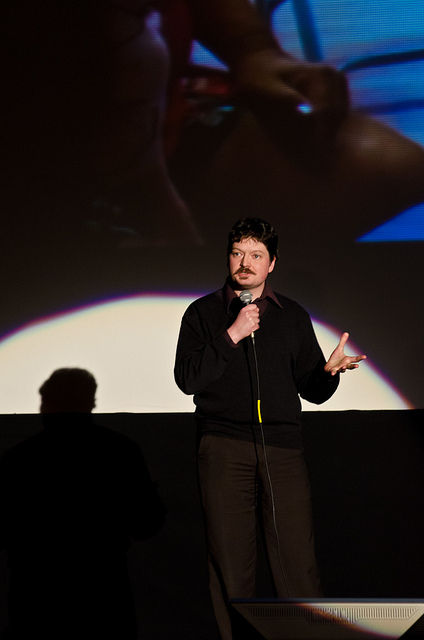
Willem Larsen on the stage of the Baghdad Theater at Ignite Portland 10 (image CC Aaron Hockley, hockleyphoto.com)

On February 9th, in Portland, OR, I had the chance to give a talk on the Language Hunter’s perspective on how we can support the revitalization of endangered languages.

Here’s a link to photos from the event – there were lots of great talks that night.

Check out the Ignite Portland homepage for more information on the event.

New eBook – “the Language Hunter’s Kit”

Language Hunter's kit cover page eBook

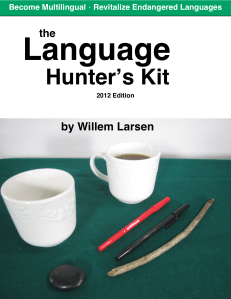
The cover to the first complete text on Language Hunting, new in 2012

With the help of the good folks at LeanPub.com, I’ve just released a work-in-progress version of the first complete book on Language Hunting, the Language Hunter’s Kit.

LeanPub offers a format where readers can purchase the eBook before it’s done, get a sneak peak, and ask questions and offer feedback that will improve their experience and make the book serve their needs better. Often a book will be published when it is only 10% done.

There is a lot more to add to the Language Hunter’s Kit book, but already it’s chock full of diagrams, instructions, stories, and tools for improving your langage learning.

As always, our goal at Language Hunters is a world full of players teaching each other to Language Hunt and become multilingual. The best way to address the world’s endangered language crisis is to remove the need to choose between languages!

And of course every copy of the Language Hunter’s Kit eBook you purchase helps fund our work.

Buy the Language Hunter’s Kit here.

Help us finish the Irish Language Hunt video series

We have 30 days to raise $3500 to complete our Irish Language Hunt video series. We’ve already put 400 man-hours into the project. Please visit our kickstarter project page:

http://www.kickstarter.com/projects/242604490/irish-language-hunt

And please tell everyone you know – by supporting this project, you support the development of the Language Hunting system for all languages. We’re already using what we’ve learned so far to plan our collaborations with other language communities.

The Irish Language Hunt is ON!

We’ve just completed a experimental series of videos in a race to “get you to the party” (achieve basic conversational fluency) in the Irish langauge (Gaeilge).

We eventually plan to have 4 Laps around the racetrack, the last two of which will get you fluent in reading and writing. So far we’ve only completed Lap 1.

If you enjoy the video above, you can start playing through Lap 1 right now. Click here to begin!

Rules of Accelerated Learning, #13: Nested Complexity

sea turtle image nested complexity accelerated learning

Observe a master navigator at work, partway through a voyage. (image CC cloning girl)

This is part of an ongoing series on the fundamental rules or “patterns” of accelerated learning. Each rule is very contextual; these are not silver bullets or cure-alls.

Rule #13: NESTED COMPLEXITY

When you are progressing through successive stages of proficiency in a target skill…

There are many models of learning out there, but they are often too general, abstract, speculative, or based on knowledge-about rather than FLUENCY.

  • It’s common when learning something new to have to go back to the beginning, and relearn things all over again, in the light of a new understanding you’ve gained. By avoiding this in the first place you can save tremendous amounts of time.
  • To really learn or teach how to do something, you must start at the most basic level of performance and rise through ever-increasing levels of complexity, becoming fluent at every step along the way.
  • Delaying fluency until you’ve had an overview of an entire skillset only means you have to start all over again to actually learn it, this time doing it for real.
  • “Maturity”-type models of learning (such as the Dreyfus Model) don’t actually tell you what to do at any particular point in your learning.
  • There are fewer ways to learn something quickly than there are ways to learn something slowly.
  • Finding a narrow path through a skillset, that you can then share with other learners/teachers, allows you to collaborate on making it even faster and more effective.
Therefore, observe your target skill at all the levels of proficiency, and map out the fastest route to fluency accordingly.
  • Rough out 4-5 main levels of proficiency, and tag them to fingers on your hand according to GESTURE.
  • When you reach a “fork in the road” along the way through the rising levels of proficiency, and both paths are equally effective, choose just one to collaborate on.
  • If there is no one who has organically learned the target skill, you’ll need to establish the levels of proficiency much later by first FLUENCY HUNTING your way through it on your own. By looking behind you, you’ll then see the path that you’ve left, and can share it with others.
  • Be aware of the overall path to mastery, but don’t engage in discussion or speculation about higher levels; focus in on the one you’re working on right now.
New teachers and learners experiencing accelerated learning often want to “jump” levels due to curiosity or impatience, to get more of an overview or exposure to the skill. This is of course the slippery slope back to knowledge-about rather than fluent mastery; call the rules of play and keep on hunting!

Rules of Accelerated Learning, #12: Gesture

Red Deer image gesture accelerated learning

There is no doubt in your mind this deer is listening to you; and yet it hasn't told you anything. (image CC dodsport)

This is part of an ongoing series on the fundamental rules or “patterns” of accelerated learning. Each rule is very contextual; these are not silver bullets or cure-alls.

Rule #12: GESTURE

When you are communicating with participants in a learning environment…

Speech, completely by itself, is a very limited way to communicate, and often causes misunderstandings.

  • Non-verbal communication comprises a substantial portion of an overall message; research has found it trumps speech through phenomena like the McGurk effect, and when it comes to communicating things like emotional states.
  • Speech only accommodates a single learning modality.
  • Gesture is the first and most accessible human language, both in terms of evolution, and in terms of a single human life-span.
  • Noisy environments can render speech communication impossible.
  • A need for silence to perform certain skills can render speech inaccessible.
  • A need to avoid interrupting another speaker can render speech unusable.
  • Deaf and hard-of-hearing youth, adults, and elders are marginalized by the emphasis on speech, and the lack of fluent signers, in mainstream society.
  • Adults who culturally identify as Deaf have a rich store of fluid, expressive mime and signs, and are great role-models for those wanting to use non-verbal communication more effectively.
  • Gesture can easily connote play, and add fun to communication, making it more ALIVE.
  • Gesture can boost SIGNAL STRENGTH to any other form of communication.
  • Gesture is “sticky”; it’s easy to recall via muscle memory.
  • Gesture/sign language is the only language that can commonly be used simultaneously with a spoken language.
Therefore, in any communication, use GESTURE to increase SIGNAL STRENGTH.
  • Create a sign along with a name when CONTRACTING a new rule of play.
  • Learn some sign language; consider even becoming fluent in your local signed language (or multiple signed languages!)
  • In any verbal communication, use signs and body language to increase the SIGNAL STRENGTH.
New learners can often be shocked that signed languages, just like spoken languages, are complex and require lots of engagement and practice to master. They are not “dumbed-down” versions of “actual” language. However, through the rules of accelerated learning, they can be quickly and easily acquired (just like spoken language.) Some cultures, for example Americans, have a very flat “affect” in communication, known by the Deaf as “paper face”. Members of these cultures need more training than others to increase their level of expressiveness. But even for expressive people, its possible to increase SIGNAL STRENGTH even more, according to the rule OVER-DO IT.

Rules of Accelerated Learning, #11: Mumble

girl phone bike image mumble accelerated learning

An expert mumbler finds a way to phone a friend. (image CC Ana_Cotta)

This is part of an ongoing series on the fundamental rules or “patterns” of accelerated learning. Each rule is very contextual; these are not silver bullets or cure-alls.

Rule #11: MUMBLE

When you are adding a new piece of ability to your current fluency, whether at the very beginning, or deep in the middle of your journey to proficiency…

The quest for perfection is the surest way to paralyze learners.

  • Learners, new to a skill, simply do not have the observational skills to even see, hear, or feel all the subtle elements involved in performance.
  • Skillful learners avoid censoring themselves, diving right into experimentation and play.
  • A fluent expression of the general structure of a skill is far more important than perfecting the details.
  • Mistakes and fumbling are the grist of learning; “An expert is [someone] who has made all the mistakes which can be made, in a narrow field.” ~Niels Bohr
  • Expertise is expressed by a mastery of the details and adaption to context.
Therefore, practice diving right into playing with your new skill and pay careful attention to your experiences.
  • Harvest and gain insight from “mistakes” or awkwardness in NO-GRIEF DEBRIEFS.
  • “Close enough is good enough”; in the beginning, when absorbing a new BITE-SIZED PIECE, abandon all concern for getting things “right” or “perfect”.
  • Use your PRESSURE VALVE to release tension, for example, by calling HOW FASCINATING! regularly when feeling overwhelmed by awkwardness.
  • Aim to express an overall FLUENCY with the general shape of the skill you are working on – don’t worry about looking good while doing it. Fluency is enough – later, expertise comes with a mastery of the details.
MUMBLE is a very new way of looking at learning; culturally, many people in the modern world are principally concerned with being “correct”. MUMBLE instead drives us to get messy, stir things up, see what happens by making lots of mistakes. This can invite a lot of criticism from those unfamiliar with accelerated learning; you’ll need to have your PRESSURE VALVE resources close at hand to deal with this kind of social pressure. MUMBLE, though effective, is only a strategy for intially encountering a piece of skill; as you become more familiar and fluent with what you’ve absorbed, your goal switches from MUMBLE to mastering the details, and perfecting your ACCENT.