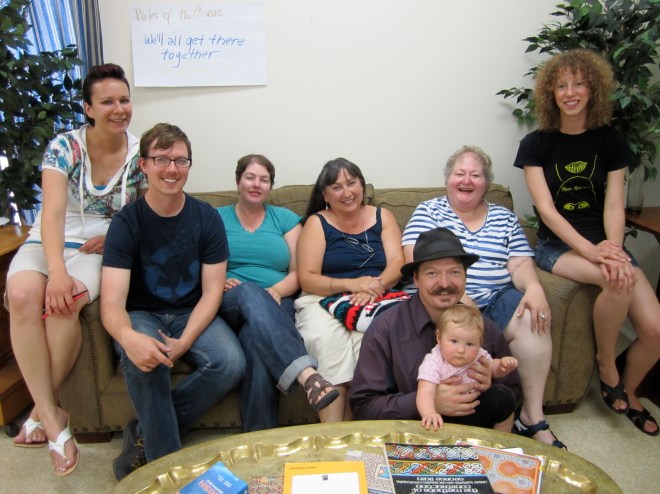
Some of the language hunters resting at the Meadow, from left: Kristena, Brían, Maldon, Maria, Willem (with Tündér), Diana, and Maggie
This past weekend, July 22-24, Language Hunters held its first workshop. The workshop took place at the Knights of Pythias community center in Aurora, OR, and focused on the Irish language as the target of our language hunting skill development.

Willem catching a quiet moment to rethink afternoon plans the first day.
I’ve been working with Irish in my spare time for several months now, working with local speakers and players to pull together a small community around a weekly Irish language night. If you’ve been following language hunting over the past few months, you’ve probably seen our videos of Irish game play.
I don’t believe in difficult or easy languages (except in obvious cases, like certain simplified pidgins and trade languages). Language all have their unique complexity, their particular personality, and the rate of fluent acquisition depends on your expectations and your mother tongue (for example, German is easy for English speakers, and Czech is easy for Russian speakers).
As it turns out, Irish has quite an array of unexpected idiom, and (in spite of the fact that it belongs to the Indo-European language family) is not at all “easy” for English speakers.
What this means, is not that Irish is a hard language, but that in order to learn Irish, there is an initial series of challenges that we need to start throwing techniques at (set-up, limit, bite-sized pieces, and so on) to get a first grasp on the “mind of the language”. Once you’ve moved through that initial complex muddle, the rest is smooth sailing.
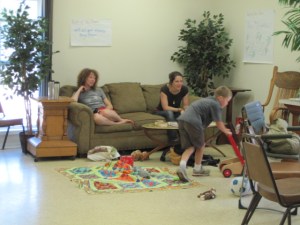
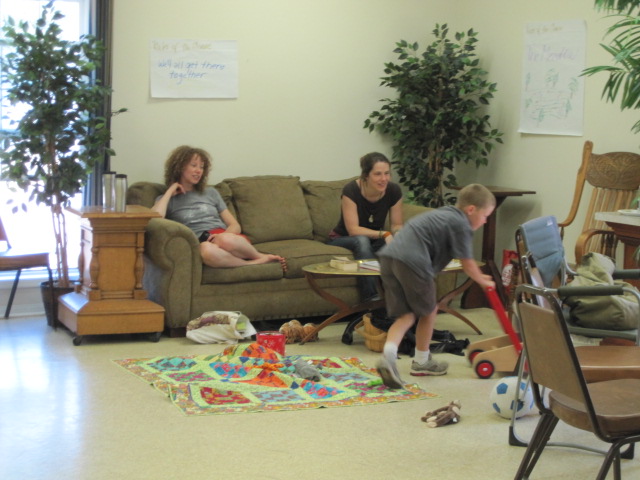
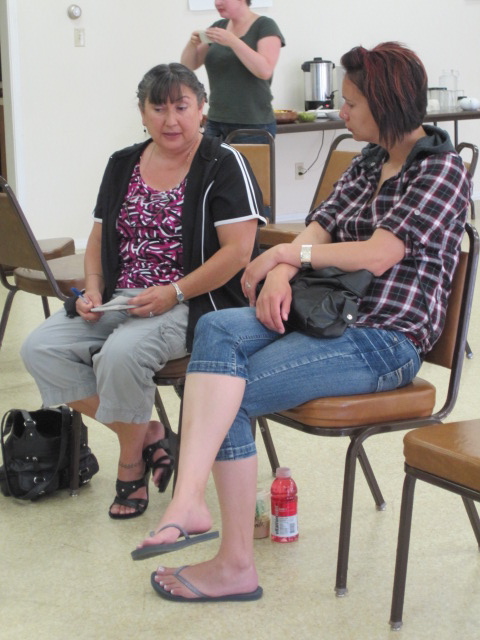
Maggie (an intern) and Jana resting in the Meadow with 8 year old Jackson
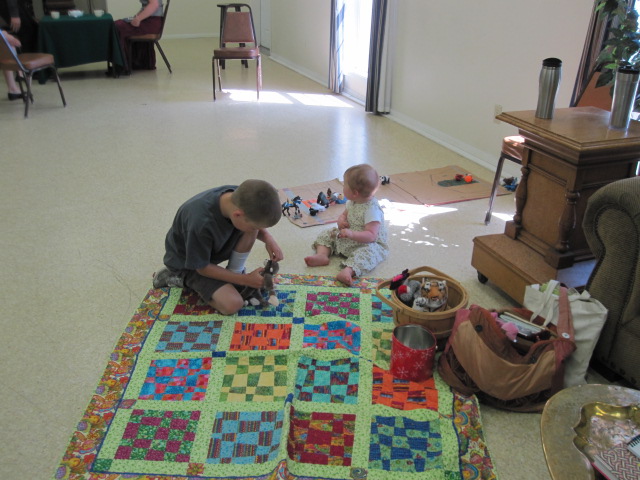
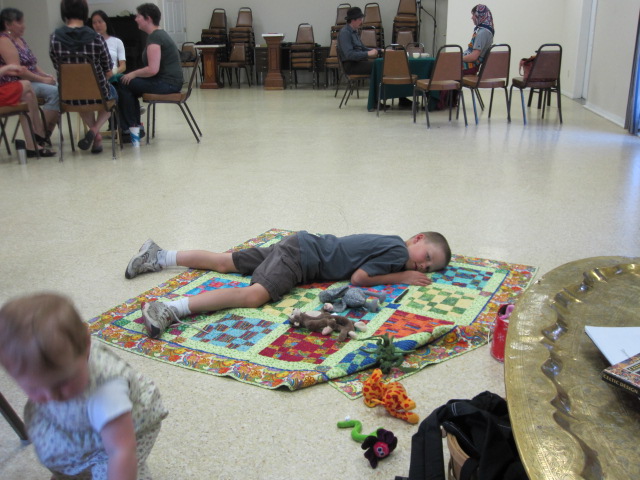
For this workshop, we placed a special focus on making sure families felt welcome and part of technique (tq) We’ll All Get There Together. To this end, the Meadow reached a peak of comfort, as you can see in the pictures – we had children’s toys, a blanket for babies to hang out on, and at one point it seemed the Meadow was about to be taken over by a growing number of small trees.
I’ve started bringing my family to Language Hunters events, as a way to role model that it really is okay to bring your children, spouse, and elders – they really do belong here. In the spirit of tq You Go First, when I realized that folks either perhaps didn’t fully believe that families had a place, or thought it was a nice idea but couldn’t see how it would work, I decided to pack the workshop with my own wife, children, and elders. As we’ve mentioned before, if the work we’re doing doesn’t apply to them, then what’s the point?
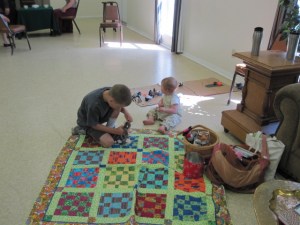
Playing in the Meadow.
Families and community are at the center of any language’s vitality – there’s no better place to start.
It’s fascinating to watch them fill the role of the Lunatic Fringe, absorbing language from a distance, periodically sitting down and signing/speaking along.
This workshop is our first one focused on a particular language, ahead of time, instead of a general “techniques of accelerated language learning”-type theme. Creating a series of conversational tq Set-ups is a big part of the initial work of language hunting, so that later players can zoom down the roadmap of language proficiency unobstructed. Brían Hart and Bob Burke, the guest fluent speakers, agreed to huddle during the weekend and figure out an improved approach for Getting to the Party, using their big-picture understanding of the language and its idiosyncracies.
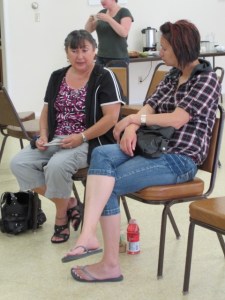
Maria and Kristena, Makah language instructors from Neah Bay, WA.
To that end, I was pleasantly surprised to have two language instructors from Makah in Neah Bay to come all the way to Aurora to learn language hunting via Irish; they understood completely that the skill is not language specific. This is pretty exciting; I know the idea of language hunting is very “out-of-the-box”, and yet it’s starting to reach folks who understand it and are excited to experience other languages to boot.
One of my big learnings for this weekend’s workshop is that I’ve realized that I’m starting to push folks too much; tq Bucket Brigade has been an element I’ve really wanted to spend time working on in these 3-day events, but it’s happened at the cost of basic skills in the Lotus.
It may be that 3 days isn’t quite enough to transition to the Bucket Brigade, which I consider a vital element of community-level language play. As you may know, we consider 3 day events as good introductions, 1-2 week events as team and hard skill builders, and 4+ week events mobilize community and turn languages around.
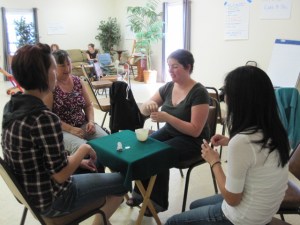
"What is that?" at the first table of the Bucket Brigade.
So therefore in ensuing workshops I’m replacing the focus on the basic skills as developed in group Lotus play.
Early implementation of the Bucket Brigade also really depends on a sufficient number of returning players (at least one for each table). There’s no way around it – to make that level of magic happen, we need trained language hunters in the room, and this either takes time or prior experience.
Tea with Grandma is connected to the Bucket Brigade, as we’re all trying to get to that table at the end of the Brigade where Grandma is sitting by rising through the proficiency levels. Brían, our Irish speaker, was a great sport, and put on a dress, apron, and head kerchief for the role.
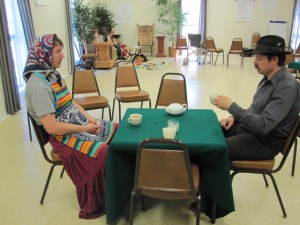
Willem hunting Grandma's language; the Meadow is in the background.
This aspect of pretend is easy to just laugh at and pass over, as it’s all in good fun, but it’s also a canny strategy for supporting language immersion. If the speaker playing Grandma really believes they’re Grandma, then all the other players switch over to an Irish emphasis; the rate of Killing Fairies drops radically, and suddenly we’re all trying to Riddle-me-this through the language, rather than looking for meaning or explanations.
It’s therefore critical to get a really good costume for your fluent speaker; and if they’re a young male, dressing in drag as a Grandma rather than a Grandpa seems to make it easier to inhabit the role. And of course, it’s also hilarious.

Full!
Our job was not to end the weekend well-rested, but to use our entire cognitive capacity to work our language hunting skills and our growing “Irish-brain”, while we had the chance. And I think we succeeded.
Unfortunately the last day of the workshop saw a heat wave – it became difficult to apply tq Warm, Fed, Rested, Safe, Willing, as the heat was making our players feel rather limp. It’s fascinating to watch what chaotic factors will creep in and undermine the best of plans; and how glad we were that whatever we could control, we did, because we know Life makes a joke out of all of our plans. By planning the weekend in a tq OCD fashion, we were able to squeeze the most learning possible out of the challenge brought by factors like the heat wave.
Within a week or two you’ll be able to see some of the curriculum videos we shot at the workshop. Keep your eyes peeled! They represent the most improved approach to date for navigating the initial exotic-ness of Irish.
Till then, Good Hunting!





 The Language Hunters' Blog